
No products in the cart.

The Fading Ghost of Banksy’s Courtroom Mural: A Symbol of Resistance?
Hey folks, grab your coffee (or tea, if you’re feeling properly British) because we’re diving into the latest chapter of street art shenanigans that’s got everyone from art nerds to armchair activists chuckling and shaking their heads. If you’ve been scrolling through your feeds this week, you’ve probably seen the buzz about Banksy’s newest stunt: a cheeky mural that popped up on the Royal Courts of Justice in London, only to get the world’s fastest spa treatment. Spoiler: the cleanup crew didn’t quite nail it, leaving behind a faint, stubborn shadow that’s basically Banksy trolling from beyond the grave. Or, you know, the wall.
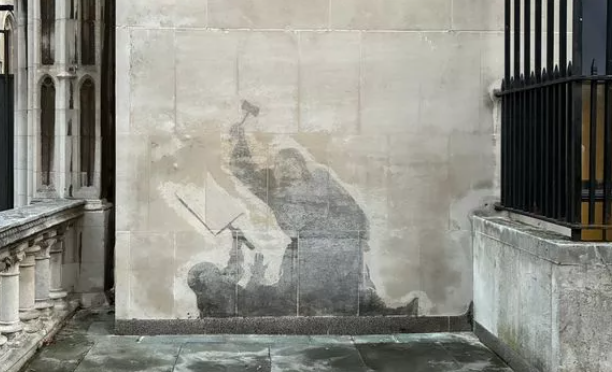
Picture this: It’s September 8, 2025 (yep, just a few days ago as I type this on the 11th), and out of nowhere, this black-and-white stencil appears on the gritty exterior wall of the Queen’s Building at the Royal Courts of Justice. We’re talking a robed judge in full wig-and-gown glory, mid-swing with his gavel, about to wallop a crumpled protester who’s clutching a placard splattered with what looks like a fresh coat of “oops, that’s blood” red paint. It’s classic Banksy—sharp, satirical, and screaming “justice system, meet irony.” Banksy, ever the shadowy maestro, drops a photo on Instagram with the deadpan caption: “Royal Courts Of Justice. London.” Boom—authenticated, and the internet explodes.
But here’s where the comedy gold kicks in. This isn’t some abandoned warehouse in Bristol; it’s the Royal Courts of Justice, a Grade II-listed Victorian Gothic masterpiece that’s been doling out High Court drama since 1882. The folks at HM Courts and Tribunals Service (HMCTS) took one look and hit the panic button. “Obliged to maintain its original character,” they declared, because apparently, a little stencil is a bigger threat to heritage than, say, a parking ticket. By September 10, security guards had slapped up black plastic sheets and metal barriers faster than you can say “objection overruled,” and a scrubbing squad rolled in with their eco-friendly (one hopes) cleaners.The Metropolitan Police even logged it as “criminal damage,” because nothing says “art appreciation” like treating graffiti like a felony.
Now, for the punchline that had me snort-laughing into my keyboard: They tried to erase it, but Banksy’s stencil was made with that sneaky, semi-permanent street art magic. What we’re left with is a ghostly outline—a judge’s robe flapping like a bad Halloween costume, the protester’s sign hovering like a half-erased chalkboard doodle. It’s like the artwork ghosted the cleanup crew. Passersby snapped pics of the faded fiasco, and social media lit up with memes: “Banksy 1, Scrubbers 0.” One X post from the Good Law Project nailed it: “The court is erasing Banksy’s mural just like it’s erasing our right to protest. It only took 48 hours.” Oof, burn.
But let’s pump the brakes on the giggles for a sec and get educational, because this isn’t just a funny fail—it’s a masterclass in Banksy’s bag of tricks. First off, the timing? Spot-on suspicious. The mural dropped right after a massive rally on September 6 against the UK government’s ban on Palestine Action, a pro-Palestinian group. Nearly 900 folks got nicked (that’s arrested, for my non-UK pals) in what critics are calling a crackdown on free speech. Banksy’s no stranger to the cause—he’s slinging stencils on the West Bank barrier like it’s his personal canvas—so this judge-vs-protester vibe? It’s a not-so-subtle jab at how the law can swing like a gavel on dissent, especially when protests hit too close to power. Think about it: In a building that’s all about “justice for all,” here’s art yelling, “Hey, what about the little guy getting whacked?”
And this isn’t Banksy’s first rodeo with the erase button. Remember the 2010 Melbourne rat that got accidentally painted over? Or the 2019 Dover Brexit mural that vanished under whitewash? Each time, the scrub sparks a bigger conversation—about censorship, value (these pieces fetch millions at auction, even sans certificate), and why we can’t just let the art breathe. One art dealer even griped that they should’ve peeled it off whole to auction for charity—talk about a plot twist!
So, what’s the big lesson here, beyond “don’t bring a sponge to a stencil fight”? Banksy’s reminding us that real protest art isn’t meant to be pretty or permanent—it’s meant to provoke, stick (literally), and outlive the cleanup. In a world where courts can “erase” voices faster than a bad tattoo, that faint outline on the wall? It’s a win for the underdog. A spectral middle finger to the system, whispering, “You can’t wash away the truth that easily.”
What do you reckon—should the Courts frame the ghost and call it “interactive heritage,” or is this just Banksy baiting us for round two? Hit the comments with your takes, and if you’re in London, go snap a pic of that stubborn shadow before it fully fades. Art like this? It’s why we love the chaos.











Leave a Reply